
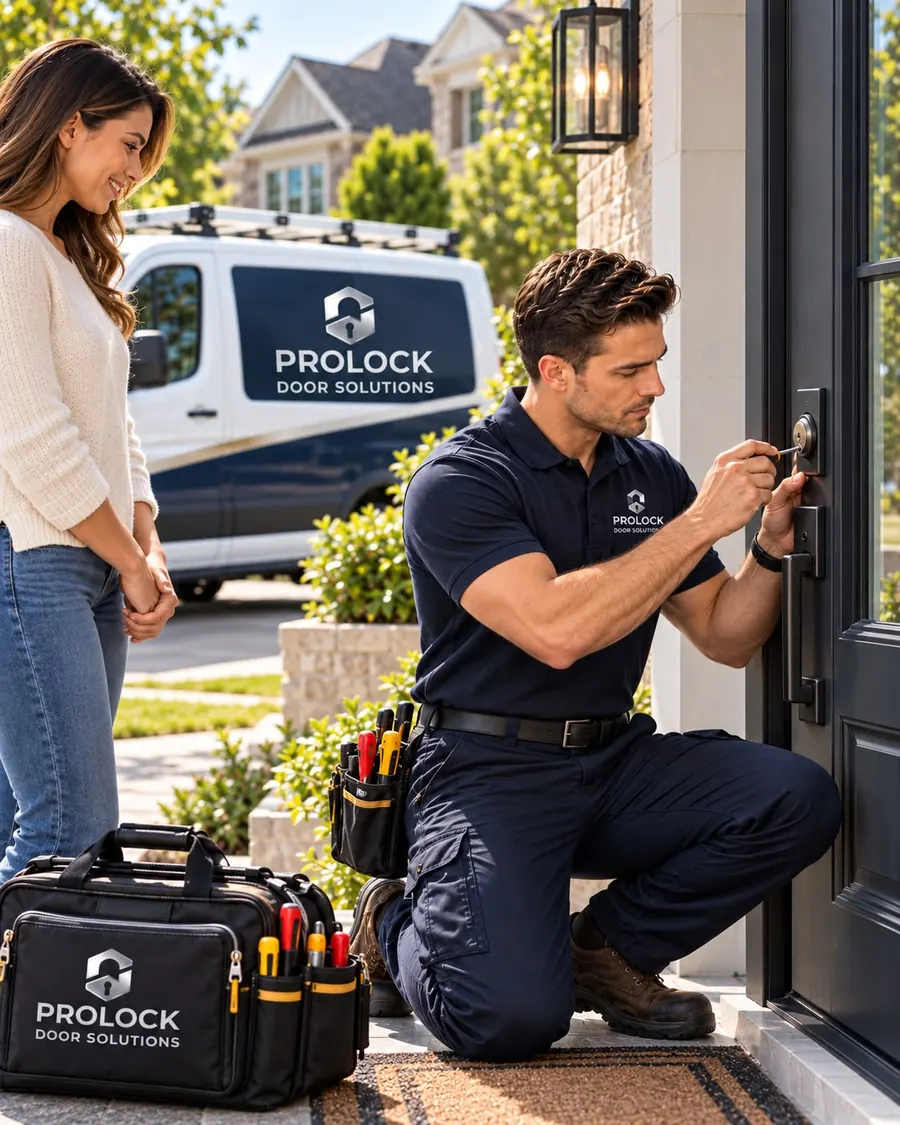
Where most doors are weak
When a door is kicked in, the lock itself usually survives. What fails is the frame around the strike plate. Many builder-grade strikes are held in by two short screws that only reach the thin trim of the door jamb. One solid kick splits the wood and the door swings open with the deadbolt still extended.
That's why a real upgrade looks at the whole opening, not just the lock.
What a proper upgrade includes
- A Grade 1 deadbolt. The highest residential grade for bolt strength and cycle life.
- A reinforced strike plate. Heavier steel with long screws, usually 3 inches, that reach the framing behind the jamb.
- Longer hinge screws. The hinge side gets kicked too.
- A full-throw bolt. We make sure the bolt extends completely into the strike, not halfway.
- Deadbolts on every exterior door. Side doors, garage entries and basement doors are often the ones without one.
Understanding lock grades
| Grade | Typical use |
|---|---|
| Grade 1 | Highest residential grade, also used in light commercial doors |
| Grade 2 | Good residential grade, common on quality homes |
| Grade 3 | Basic residential, often found in builder-grade sets |
Grades are set by ANSI/BHMA testing for strength, durability and resistance to forced entry. The grade is usually printed on the packaging, and we'll tell you what you currently have.
High-security cylinders
A high-security cylinder adds protection against picking, bumping and drilling, and most use a restricted key that can't be copied at a hardware store without authorization. That last part matters more than people expect. With a restricted key, you know exactly how many keys exist.
High-security locks make sense for:
- Homes where keys have been lost or copied in the past
- Rental units and multi-family homes
- Detached garages, workshops and outbuildings with valuable tools
- Homeowners who simply want the strongest option
Single or double cylinder?
A single cylinder deadbolt has a key outside and a thumbturn inside. A double cylinder needs a key on both sides, which can help on doors with glass near the lock. The trade-off is safety: in a fire, you need to find the key to get out. For most homes we recommend single cylinder deadbolts and, where glass is a concern, stronger glass or a different lock position.
Before a trip
If the house will be empty over a holiday or vacation, it's worth checking every exterior door before you leave. A stuck deadbolt that people have stopped using is a common gap.
Deadbolts for the doors people forget
When we check a house, the front door usually has the best lock. The weak points are elsewhere:
| Door | Common problem | Upgrade |
|---|---|---|
| Garage entry into the house | Knob lock only, often left unlocked | Deadbolt or keypad deadbolt |
| Back or side door | Old deadbolt that no longer fully throws | New Grade 1 deadbolt and strike |
| Basement walkout | Thin door, short strike screws | Reinforced strike and long screws |
| Detached garage or shed | Padlock on a weak hasp | Deadbolt or bolted hasp with a closed-shackle padlock |
Upgrading every exterior door to the same deadbolt also lets us key them alike, so the stronger house is simpler to live in, too.
Common questions
Can you upgrade the deadbolt without replacing the knob?
Yes. The deadbolt and knob are separate. We can upgrade the deadbolt alone and key it to match your existing knob.
Is a reinforced strike plate worth it?
Yes. It's one of the most effective upgrades for kick-in resistance, and it works with your current deadbolt.
Do high-security locks use special keys?
Most do. They use restricted keys that can only be duplicated with authorization, usually with an ID card or signature on file.