
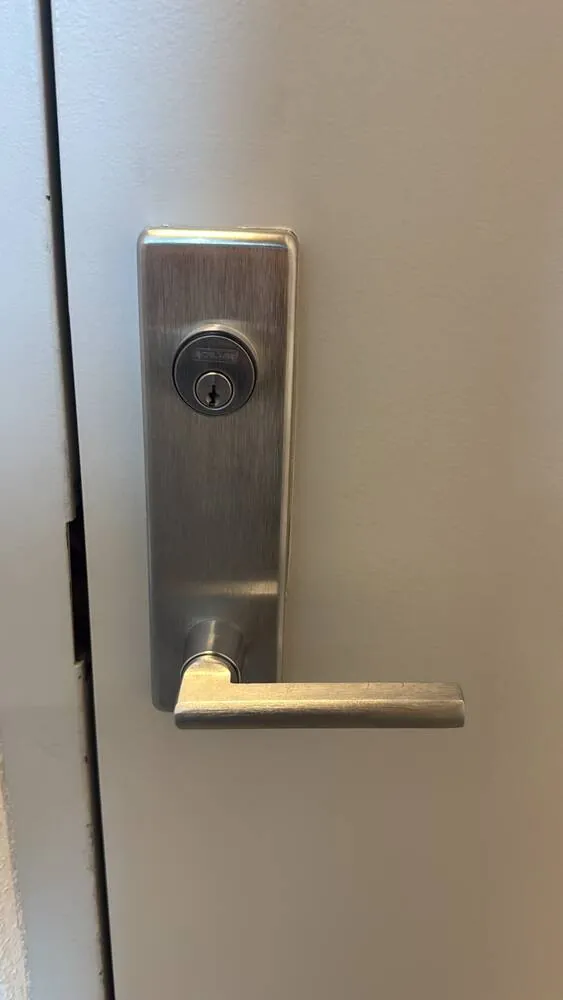
A small business needs a master key system when two things are both true: several people carry keys, and those people shouldn't all be able to open the same doors. If that describes your shop, office or practice, a master system lets the owner carry one key while staff carry keys that open only what they use. If it doesn't, because you have one entrance, a back door and two trusted keyholders, a master key system is probably more than you need, and simpler options do the job. This post walks through how to tell which side of that line you're on, what the trade-offs are, and what to think about before calling for a master key system.
Signs you've outgrown a plain set of keys
Most businesses don't plan a key system. They start with whatever locks came with the space, then add a key here and a copy there. A few years later, nobody is sure how many keys exist. Here are the signs that it's time to get organized:
- The manager's key ring is getting heavy. Front door, back door, office, stockroom, utility closet, cash room. If one person needs six keys to open and close, a master can replace them with one.
- Some rooms should stay off-limits. The office with payroll records, the medication cabinet room, the server closet or the stockroom with high-value items.
- You have shifts. Openers, closers and weekend staff need different access, and handing everyone the full ring is the easy but risky way to cover it.
- Outside people need in. Cleaners, maintenance contractors and delivery drivers who need one or two doors, but not your office.
- You can't count your keys. If you'd have to guess how many copies of the front door key exist, that's the real problem, and a master system with records is one way to fix it.
When a master system is more than you need
Not every business benefits. Master keying adds planning and record keeping, and it doesn't make sense for every space. You may be fine with something simpler if:
- You have one public entrance and one back door, and the same two or three people use both.
- There are no interior rooms that need to be locked separately.
- You rent a small suite where the landlord controls the building doors.
In those cases, keyed-alike locks, where one key opens all your doors, are often enough. Another option is a keypad or card lock on the main door, so staff use codes that can be changed or turned off, while the back door stays on a key held by the owner. Our access control page covers how codes and fobs work alongside keys.
The trade-offs to know about
A master key system is a good tool, but it has costs beyond the work itself.
A lost master opens a lot of doors
That's the whole point of a master key, and it's also the risk. If an employee loses a key to one office, you rekey one lock. If someone loses the master, every lock it opens needs attention. That's why masters should go to as few people as possible, and why a restricted keyway, which can't be copied at a hardware store, matters more in a master system than anywhere else.
Records only help if someone keeps them
A master system comes with a key schedule: which key opens which door and who has each one. If the schedule gets lost in a drawer and keys are handed out without being written down, you're back where you started, just with fancier locks. Pick one person who owns the list.
Not every lock can join
Plenty of the cylinders already on your doors can usually be repinned to work with a master. Some older or mismatched hardware can't, especially when a space has been through several tenants and a mix of lock brands. A walk-through tells you which locks can stay and which would need new cylinders.
How it plays out in a typical Nashua business
Nashua has a mix of small business spaces: storefronts along Main Street downtown with a stockroom and a back alley door, retail units on Amherst Street and Daniel Webster Highway, and office and medical suites in the buildings off Spit Brook Road. A few examples of how the decision tends to go:
| Type of business | What usually makes sense |
|---|---|
| Small retail shop, owner and two employees, front and back door | Keyed-alike locks, with a restricted key if copies are a worry |
| Restaurant with managers, kitchen staff and a cleaning crew | A small master system: managers open everything, staff open the back door, the office and liquor storage stay restricted |
| Medical or dental suite | A master system with records and medication rooms keyed separately from exam rooms |
| Office with several departments, or a building you own and lease out | A full master system, often with access control on the main entrances |
These are starting points, not rules. A three-person office that handles client files may want more control than a busy shop with nothing in the back but boxes.
Questions to answer before you call
If you think a master system might be right, having these answers ready makes the first conversation much more useful:
- How many doors have locks? Count interior doors, closets and cabinets too, if they're locked.
- Who needs to open what? A rough list by role is enough: owner, manager, staff, cleaning crew, contractors.
- Do you own the building or lease? If you lease, check your lease and talk to the landlord before changing any locks, especially on building entry doors.
- How many keys are out there now? Even an estimate helps.
- Are you planning to grow? A system designed with room to add doors and key levels saves rework later.
If staff turnover is what started you thinking about this, our post on what to do with the locks when an employee leaves covers that side of it. And you can find more about our work across the city on our Nashua locksmith page.
What setting one up involves
We start with a walk-through of every door and a conversation about who needs access to what. From that we put together a keying plan, check which of your existing cylinders can be used, and explain the work and what it costs before anything starts. Then every cylinder is set up to match the plan, and each key level is tried in each lock, and you get a key schedule to keep. Many businesses do it in stages, starting with the outside doors and the most sensitive rooms and adding the rest later.
Is a master key system less secure than regular locks?
A lock that opens with more than one key has a little less resistance to picking than one that opens with a single key, and a lost master exposes more doors. For most small businesses, that's outweighed by knowing who holds which key, especially with restricted keys that can't be copied without your permission.
Can we keep our existing locks?
Often, yes. Most existing commercial cylinders can be repinned to fit the new keying plan. We'll tell you during the walk-through which ones can stay and which would need new cylinders.
What's the difference between keyed alike and master keyed?
With keyed-alike locks, one key opens every lock, and everyone who has a key can open everything. With a master system, each lock has its own key plus a master that opens a group of locks, so access can be different for different people.